
We find that teachers often assume that the entry point for working with a coach is to identify a goal for themselves, or that coaching is about all of the things they should be doing in their classrooms. This typically surfaces at the beginning of a coaching cycle when a teacher asks for support with a new initiative or instructional practice. It may sound like, “I need to incorporate more discourse strategies into my teaching, can you help me with that?” “I need to do a better job managing my students’ behavior” or “I have to start using the new math program that our district purchased.”
Examples of Coaching Cycle Goals
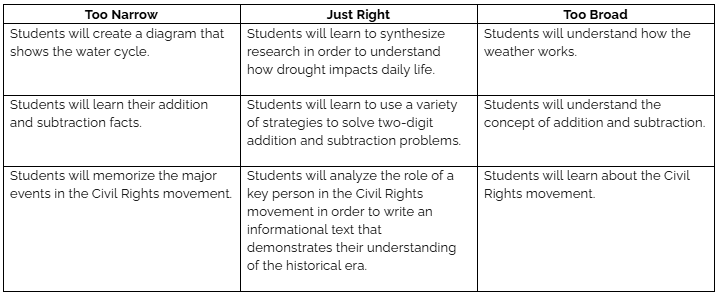
We take a different approach. When kicking off coaching cycles, we set standards-based goals using the language, “Students will learn. . . ” because it ensures that we are student-centered in our goal setting process. But this isn’t enough. If a goal is going to impact student learning, then it needs to be just the right size and scope. We like to think of these as ‘Goldilocks goals,’ or goals that are just right. The following figure provides examples of goals that are too narrow, too broad, and just right. As you look through these examples, you’ll likely notice that the ‘just right’ goals are challenging, include a combination of knowledge and skills, and may even represent more than one standard. This provides the opportunity to focus on deep learning across a coaching cycle.
Language Stems for Goal Setting
The following language stems support the goal setting process. You’ll notice that the questions are grounded in what we hope to see the students learning, rather than on what we think the teacher should (or shouldn’t) be doing in the classroom. Taking this approach goes a long way in building partnerships that focus on moving student learning forward.
- What do you hope the students will learn as a result of our partnership?
- Let’s look at the standards. How might they help us choose a focus?
- What would you like to see your students doing as (readers, writers, mathematicians, scientists, etc.)?
- Is there any student work or data that could help us decide on a focus that would make the most impact on your students?
- How do you feel about the goal we’ve selected? Does it feel right to you?
In Closing
We view goal setting as an opportunity to establish that coaching is about partnering with teachers to reach their goals for student learning. This shifts the perception away from coaching being about ‘fixing teachers’ and goes a long way in building trust. If we begin here, then we begin our work in a student-centered way.